

Leather is one of the few materials that genuinely improves with use, provided you start with something worth wearing. A wallet that softens and darkens at the corners over five years is a different object entirely from one that splits along the fold in eight months, and in an online listing the two can look almost identical. Here is what to check, roughly in the order that matters, before you spend money on a belt, bag or wallet.
Start with the hide, not the label
Leather is graded by how much of the original hide survives the finishing process. Full-grain leather keeps the whole surface, including the natural grain and any marks the animal picked up along the way. It is the most durable option and the one that develops a proper patina. Top-grain has been sanded lightly to level out blemishes, which makes it more uniform and slightly less tough. Corrected-grain leather has been sanded hard and embossed with an artificial grain; it photographs well but the strongest outer layer is gone. Split leather is the lower part of the hide, and bonded leather is scraps and fibres glued to a backing. Bonded leather flakes.
If a description leans on the phrase “genuine leather” and says nothing else, treat that as a prompt to ask more questions rather than a reassurance. The term covers a very wide range of quality. Tanning matters as well: vegetable-tanned leather is firm, ages warmly and suits belts and tooled work, while chrome-tanned leather is softer, more water-resistant and common in bags. Neither is inherently better — they are suited to different jobs.
Quick checks you can make in person or on delivery
- Press a thumbnail into the surface. Full-grain creases lightly and springs back; corrected grain tends to look flat or plasticky.
- Look at a cut edge. Solid leather shows a dense, fibrous cross-section. Visible layers mean bonded or split leather with a coating.
- Smell it. Leather smells like leather. A sharp chemical or plastic smell usually points to a heavy finish or a synthetic backing.
- Turn a belt over. If the reverse is a different colour and feels slick, it is probably a split with a painted coating.
Stitching tells you almost everything
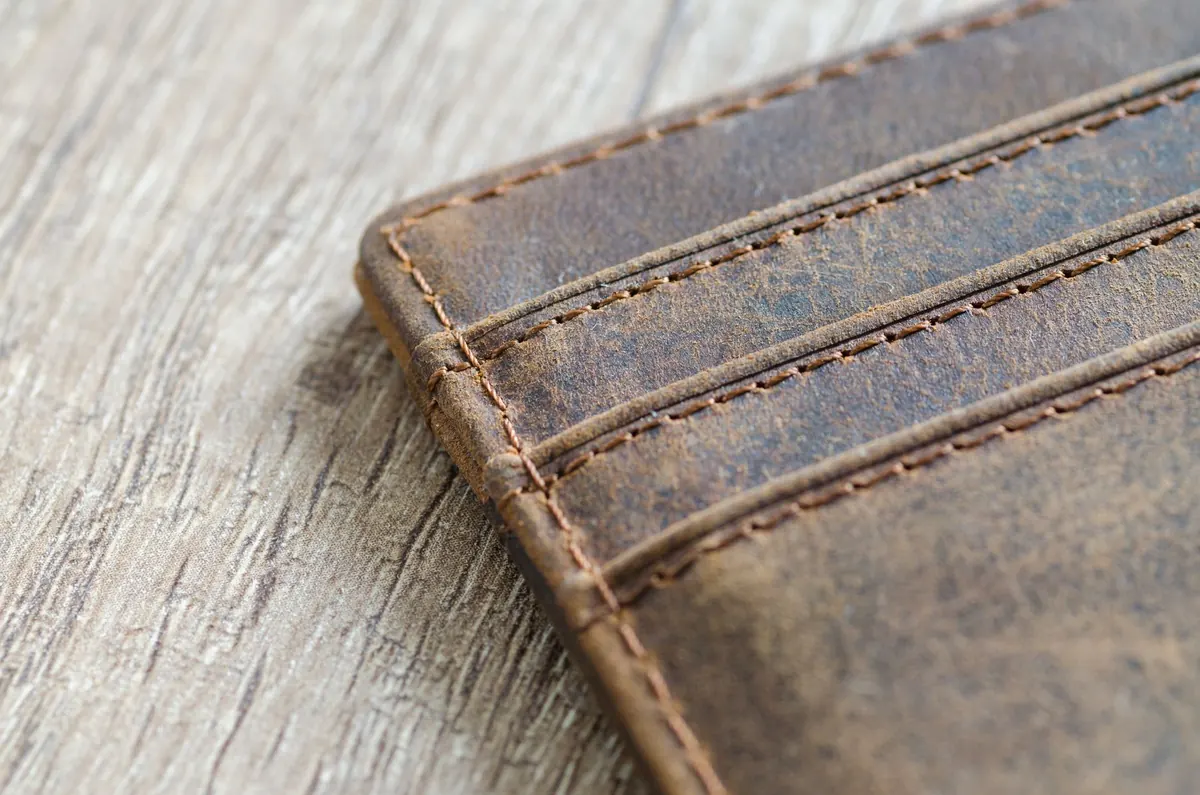
Run a thumb along a seam and look closely at it in good light. Hand saddle stitching uses two needles and one waxed thread worked through the same holes from both sides, so the stitches sit at a slight slant and stay put if a single stitch fails. Machine lockstitching is faster and perfectly good when it is done well — the trouble is when it is not. Watch for uneven spacing, skipped stitches, thread that has cut into the leather, puckered seams, or a row that wobbles away from the edge.
Thread should suit the leather: thick enough to hold a heavy bag together, not so thick that it tears the hide. Seams ought to start and finish with a backstitch, and the loose ends should be buried or neatly melted rather than left dangling. A maker who shows you a close-up of the back of a wallet is usually proud of it.
Hardware, edges and the details nobody photographs
Hardware is where costs get trimmed invisibly. A stamped, thin buckle will bend the first time you tug it; a solid brass or stainless steel buckle will outlive the belt. Look at the weight of it in your hand, and check that rivets are solid rather than hollow shells. On zips, metal teeth and a reputable brand name are reasonable signals, though a well-fitted plastic zip on a wash bag is no disaster. Snaps and clasps should close with a firm click, not a vague squish.
Edges are the tell. Burnished and waxed edges — where the maker has slicked the raw edge until it seals — are the mark of careful work and hold up best on vegetable-tanned leather. Painted edges look crisp but can crack and peel with flexing. Raw edges are fine on some designs and scruffy on thin leather. Inside a bag, a lining of suede, pigskin or sturdy canvas protects the contents and hides the back of the stitching; an unlined bag is fine if the reverse is neat.
Sizing: get this right before anything else
Bad sizing is the most common reason a good piece ends up in a drawer. Measure a belt you already wear from the fold where it meets the buckle to the hole you use most often. That measurement, not your trouser size, is the belt length to order. Most belts have five holes an inch apart with the middle hole at the stated length. If you are between sizes, size up — punching an extra hole is simple, and shortening a finished belt is not.
Bags are trickier, because external dimensions tell you very little. Ask for internal measurements and the strap drop. Then measure a bag you already carry: the drop that sits comfortably on your shoulder is usually a couple of centimetres more than you would guess. A bag that is heavy before you have put anything in it is one you will quietly stop carrying.
For wallets, count your cards first, then count the slots. Check how thick it becomes when full and whether that fits the pocket you have in mind.
- Belt: buckle fold to favourite hole.
- Bag: internal width, height and depth, plus strap drop.
- Wallet: card slots, note compartment, closed thickness when full.
Caring for it without ruining it
- Keep it dry. If it gets soaked, blot it and let it dry at room temperature, well away from radiators and direct sun.
- Clean with a barely damp cloth. Use mild soap only on greasy marks, then wipe with clean water and let it dry.
- Condition sparingly — a small amount twice a year, worked in with your fingers, with the excess buffed away. Over-oiling softens leather and can stretch it out of shape.
- Test any new product on a hidden patch first, especially on pale colours.
- Store bags stuffed and upright in a dust bag, hang belts from the buckle rather than rolling them tightly, and resist overstuffing a wallet.
Questions worth asking the maker
- Which tannery does the leather come from, and is it full-grain?
- Is the piece hand-stitched or machine-stitched, and what thread is used?
- Is the hardware solid brass, stainless steel, or plated?
- Do you repair your own work?
- Can I see photos of the back, the edges and the inside?
Choosing one thing and using it
Buy the piece you will reach for every day rather than the one that looks best under studio lighting. Solid hardware, even stitching and a hide that has not been sanded into submission will see you through years of use, and the marks that accumulate are the point rather than a flaw. A maker who offers repairs and answers questions about materials is usually worth paying a little more for, because they expect the piece to come back. Start with one item — a belt is a sensible first purchase, since the sizing is easy and the construction is visible — and let it tell you who you want to buy from next.
Photo: Lukas Blazek / Pexels
Related posts
More stories you’ll love reading